
Stop paying Sonnet prices for Haiku work
How I cut a lead-triage workflow's AI bill in an afternoon, and the one node I left alone
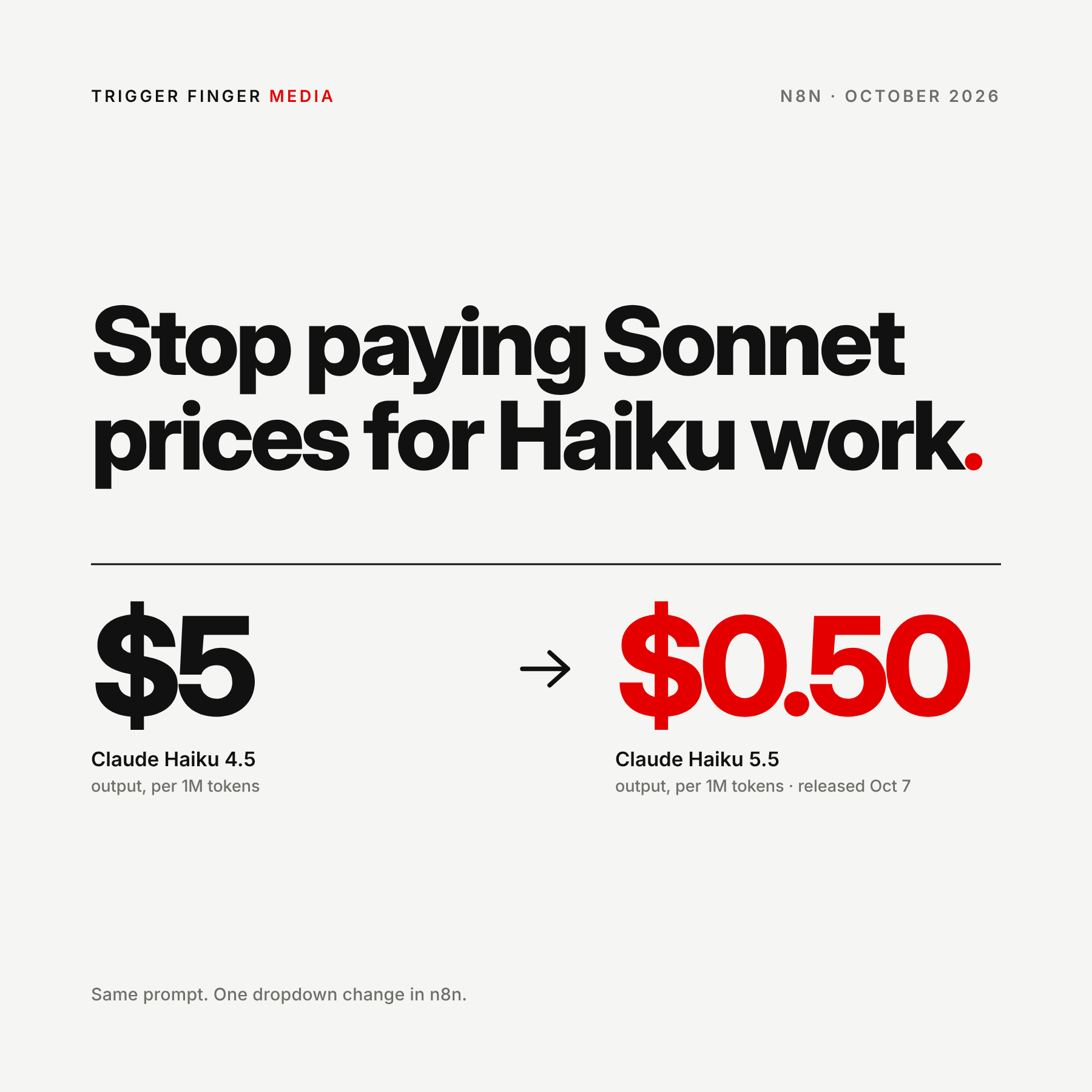
Most n8n workflows I look at run every AI step on the same model. Not because anyone decided that. The template came with one model picked, every node that got added later inherited it, and once the workflow worked nobody opened the dropdown again.
That was a rounding error when the workflow ran fifty times a month. It stops being one once the business depends on it.
On October 7, Anthropic released Claude Haiku 5.5 at $0.10 per million input tokens and $0.50 per million output tokens for prompts under 100K tokens. The previous Haiku was $1.00 and $5.00. Anthropic's own estimate is about 75% lower cost on an average workload, which is less than the sticker price suggests because the new tokenizer uses somewhat more tokens. Still, a tenth of the per-token price is the kind of change that's worth an afternoon.
One question per node
The idea is simple enough to say in one sentence: a model only has to be as smart as the single step it's doing, not as smart as the whole workflow.
So at each AI node I asked one question. Does a person read this output, or does the next node?
If the answer is "the next node," it's small-model work. Classification, extraction, summarizing, routing. The output gets checked by a rule or consumed by another step, and a bigger model doesn't make a JSON field more correct.
If the answer is "a person," it's big-model work. Tone matters, a bad sentence costs you something, and the few cents you'd save aren't worth it.
The workflow
This is a lead-triage flow for a service business. A form submission comes in from the website, the workflow figures out what it is and who should handle it, writes it to the CRM, and sends the lead a first reply. There are six AI nodes in it.
| Node | What it does | Where it went | Effort |
|---|---|---|---|
| 1 | Classify the submission: lead, vendor, spam, support | Haiku 5.5 | Low |
| 2 | Extract company, service wanted, budget band, urgency as JSON | Haiku 5.5 | Medium |
| 3 | Write a two-sentence summary for the CRM note | Haiku 5.5 | Medium |
| 4 | Decide which rep and which pipeline | Haiku 5.5 | Low |
| 5 | Draft the first reply the lead receives | Sonnet 5.5 (unchanged) | — |
| 6 | Weekly digest of all leads for the owner | Haiku 5.5 | Medium |
Five moved. One stayed.
How to do it in n8n
Open the Anthropic chat model sub-node attached to your AI Agent or Basic LLM Chain and change the model to claude-haiku-5-5. That's the whole switch. Don't touch the system prompt yet.
Haiku 5.5 has an effort setting with low, medium and high levels, and medium is the default. For routing and classification, low is usually enough and it's faster. For anything producing structured output, I leave it on medium. If your n8n version doesn't expose effort in the node options yet, the default is fine.
Then test it properly. Pin ten to twenty real past inputs on the trigger, run the workflow, and compare the outputs to what the old model produced. The point isn't to eyeball it; it's to diff it. On this workflow, the classifications and extracted fields matched on all 10 runs, and the CRM summaries were different wording with the same facts.
If a node's output got worse, bump its effort to high before you move it back to the bigger model. Most of the time that's enough.
Finally, read the numbers. Token usage is in each node's output, so cost per execution before and after is a short calculation: input tokens times the input price, plus output tokens times the output price, for each node you moved. For a sense of scale, at list prices a node that reads 2,000 tokens and writes 400 costs about $0.004 a call on Haiku 4.5 and about $0.0004 on Haiku 5.5. Across five nodes, that's roughly two cents a run down to a fifth of a cent, or about $20 a month down to $2 at 1,000 runs. Your own numbers will differ, and because the new tokenizer uses somewhat more tokens, expect the real saving to land nearer Anthropic's 75% estimate than the 90% the price list suggests.
One more thing worth turning on: prompt caching, for any node with a long fixed system prompt. Cache reads on Haiku 5.5 are $0.01 per million tokens, so a long instruction block stops costing you anything after the first call.
The one I left alone
Node 5 writes the reply the lead actually reads. It's the only output in the workflow that a prospect sees, and it's the one place where a slightly better sentence has a real dollar value.
Sonnet 5.5 still leads Haiku on every evaluation Anthropic published alongside the release, and that gap shows up in exactly this kind of writing: the reply that sounds like a person at the company rather than an autoresponder. It costs more per run. It's worth it.
Three caveats
The 75% number is Anthropic's average estimate. Your mix will differ, and if any of your prompts go over 100K tokens you're in a higher pricing tier, so check that before you assume.
Re-test anything that returns strict JSON. A new model and a new tokenizer can change formatting edge cases, and a node that worked for six months can start returning a trailing comma. The diff step above catches this; skipping it doesn't.
And for the first week after a switch, spot-check the nodes that decide who gets contacted or what lands in the CRM, even if the test runs matched. Those are the ones where a wrong answer is quiet.
If you run n8n for your business
If you haven't looked at which model each node uses since the day you built the workflow, this is an afternoon of work with a real payoff, and most of it is opening a dropdown and running a diff.
If you'd rather have someone go through your workflows with you, that's part of what we do at Trigger Finger Media. Get in touch.